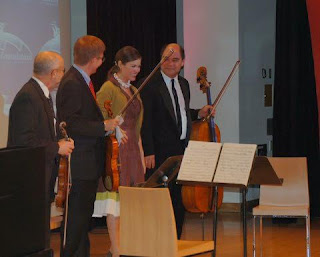
 |
| With the Terezin quartet at The New School in New York City |
I'm a doer. It's the way my little soul entered my
frequently-challenged body. When I couldn't keep up with my peers, I
tried harder. I went to the gym more. I dieted. But no matter how hard I
tried to keep up, lose weight and exercise, physical activity just
appeared to be much easier for other people. In certain respects, it was
a blessing. Turning my attentions to music and academics has been a
much more sustainable road to happiness, a career and a life for me.
I
was diagnosed with a stage IV case of IPAH when I was 20. I was
transplanted the first time at 26 and then again two years later. Over
those years, it became clear that "my" mindset and can do attitude
wasn't mine alone. It belonged to many of the people I met who had
Pulmonary Hypertension. But once a diagnosis comes, how do we
cope? How do we move forward with a life despite the seeming
impossibility of our situation? How did I move forward?
The value of worthy distractions
 |
A performance at a TED conderence at the
Hotel Del Coronado on Coronado Island, CA |
The
grief associated with diagnosis can be overwhelming for an individual
and for a family. It's almost like having your funeral while you're
alive. But in the midst of the emotional avalanche, I looked towards my most cherished distractions.
After diagnosis, my family and I felt lost in the hyper-realism of our
word. Everything was so clear; so poignant; so beautiful and painful, it
seemed there was little to nothing we could do. While my specialist in
Colorado (Chris Lang at Kaiser if anyone is wondering) was amazing,
another specialist told me singing would kill me. Because of the
severity of the diagnosis, we didn't know if I had weeks, months or
years left but the prospects didn't look good. Almost as soon as we
found out, I focused on a project. If I was going to die, I wanted my
family to have a record of my voice. I put together the music and found a
pianist. A friend who managed a recording studio donated the time for
me to record. It was a gift for which I will always be deeply grateful.
In those first weeks, it gave me a place to escape the seeming bleakness
of my reality. Meanwhile, I began to subconsciously process everything
that was happening to me. By the time the recording was done, I was much
better prepared to emotionally cope and chart a path forward.
 |
With my family at the Cleveland Clinic
|
Focus on the CAN
My
physical, spiritual and emotional well-being were largely grounded in a
determination to focus on the can instead of the can't. The body is
amazing. It learns to cope -- to pace itself -- but I think the only way
that happens is if we embrace the possibilities we have as opposed to
lamenting over those we don't. Despite the clumsiness of my pump (in my
day, it was really big), the shortness of breath, synchope (sp??) and
complicated medications, I learned how to really live with PH. I
couldn't run a marathon, but I could sing. I wasn't going to be a great
mountain climber, but I could paint. I couldn't eat salt, but good
fruit is the best thing in the world anyway and it doesn't need salt. I
couldn't climb to the top of the Washington Monument, but I could get
another graduate degree. I couldn't play intermural sports but I could
run an after school music program for kids in Baltimore. I learned my
limits and how to live within them. Eventually, I lived in Italy,
Hungary, Israel and in China all while I had PH. I performed in major
theaters around the world. I met my future husband and fell in love. By
focusing on what was possible, my emotional and spiritual health was
excellent which in turn, helped me professionally and my overall
physical well-being.
I Never Wanted A Transplant
 |
| A performance in the US Capitol Rotunda |
 |
With my lift team at the Cleveland Clinic
|
Transplant
is undeniably amazing. It's also a challenge. First, let's talk about
amazing. I never could run. Seriously. From the time I was a little
girl, it just wasn't something I was able to do. But the other night, I
ran all of the way from our flat to the Lincoln Memorial in Washington
DC with my husband. Its something that until I did it, was unimaginable.
I never feel like I'm going to faint anymore. This is also a huge deal
since much of my life was spent trying to figure out whether an activity
would land me unconscious. I can eat salt and people finally really
enjoy my cooking -- something that was a challenge when I couldn't add
salt to anything. I don't have the pump anymore. I'm married (though I
suspect my husband and I would have married regardless of whether I
received a transplant since we began dating when I had PH). We just took
an amazing trip to Patagonia where I climbed some of the most beautiful
mountains in the world. Life is good. The challenge is, this is my last
shot. When I had PH, if things went south there was always another
medication they could add to my regimen or if all else failed,
transplant. There is no safety net for transplant. I was crazy fortunate
and my insurers and hospital let me go on the list for another
transplant and I got it, but that doesn't always happen.
A first transplant is hard enough to get. A second transplant is nearly
impossible. The word rejection is super apt
 |
| Relearning how to climb stairs after the transplant |
because when it happens, it
feels like the organs are rejecting you, personally. Its like the old,
more vengeful version of God right inside of you all of the time. It
knows whether I took my meds on time, whether I ate shellfish, whether I
crossed my legs, whether I'm exercising, whether I am doing everything
I'm supposed to do. When I rejected, I experienced guilt in a way that I
never had before. It reminded me of when I didn't get into the college I
wanted to go to, steroids. It was
devastating and I felt like I was making my donor die all over again.
The process of watching my body break down so quickly didn't give me
time to grow used to my condition. It was hard and fast and
cruel. With
PH, right before my 1st transplant, I didn't want one. All I wanted was
to move to Canada to be part of one of Duncan Stewart's stem cell
studies. I could still walk around -- albeit slowly. I wanted a cure,
but if one never came, I was happy to spend my life living with PH. I'd
already been diagnosed with PH for over 5 years and I was very happy
with my life. While I was on loads of meds -- revatio, aspirin,
diuretics and flolan among others -- I was used to living with and
coping with my disease. What I didn't totally accept until two friends
with PH died was that there is a window of opportunity for transplant.
Wait too long and it closes. When I crawled through my window, the glass
was broken and it left some nasty scars, but it lead to somewhere
amazing. There is a story of a young woman who's removed her name from
the transplant list in England because the wait is too hard and she
wants to travel the world. While I understand her sentiment -- I kind
felt the same way for many years -- being on this side of the experience
I am so grateful to have made it. My life is filled
 |
| Our wedding |
 |
| With my husband in Palos Verdes, California |
with people and
things I love. While I can't go clubbing, I can do so many things that I
love to do and I am discovering so many other things that were out of
reach for many years of my life. Transplant made me grow up. When I had
PH, I would imagine a cure and imagine all of the things that could
happen. Transplant has taught me that I am the ultimate arbiter of
possibility. Every single day depends on me taking my medications on
time, exercising, recording my spirometry, washing my hands, avoiding
crowded places, wearing my mask on the plane. It has forced me to
discipline myself in ways I never thought was possible. It's taught me
to be more humble -- to accept help and really lean on the understanding
of others. It wasn't my first choice, but it is a huge blessing.
The Take Away
I
want a cure. I hope and dream and pray for one. But for now, I try and
focus on what I can do with my doctors, with my community, with my
family and my friends. In the last weeks of waiting for my first
transplant, I painted a beautiful table. It sits in my front room as a
reminder of the beauty that can come in our darkest hours. If we look
towards action, it will wisk us away and carry us toward the wondrous.
 |
| The table I talk about at the end of the post |
Happy breathing.
 |
| With my sisters after my wedding |
Charity
Tillemann-Dick is a best-selling classical artist and writer. Last
summer her album American Grace charted 10 times on the Billboard charts
including the number 1 slot as top classical album. Along with her
popular lifestyle and cooking blog 5istersTD she is a contributor to CNN, Huffington Post
religion and arts sections. Currently, she is writing a memoir which
will be published with Simon & Schuster in the spring of 2016. You
can follow her on twitter and instagram @charitytd. It might take a little while, but she promises to tweet back.


 bad. Every minute of every
day it hurt.
After 1 false call the day finally came. I got my lungs! 12 days in the
hospital and I got to go home. I pushed hard and recovered fast! Now as I
sit here healthy and being able to breath once again I will never
forget how lucky I am. I love my life! I am extremely thankful to both
my donors. Organ donation is incredible! I get to be a dad, a husband,
son and friend.


