Showing posts with label personal. Show all posts

Thursday, 23 June 2016

How My Diagnosis is Hurting Me

"What's wrong with me?"

This was a question I found myself asking only a couple of months before being diagnosed with Pulmonary Hypertension. Upon diagnosis an expiration date was stamped on my back like a carton of milk. I was officially diagnosed with Stage 3-4 'Idiopathic Pulmonary Arterial Hypertension.' The word idiopathic is a fancy word meaning that the doctors have no idea why I developed this disease. There was no rhyme or reason.

The word 'idiopathic' attached to my medical files has almost felt like a curse.

Upon diagnosis, blood work was drawn to see if the PH was caused by a secondary condition. But this only weeds out diseases that are detectable through routine blood work. Often times, PH is caused by a secondary disease. If the secondary disease is managed, it can potentially help stabilize the condition of the PH.

I have tried very hard for over two years now to seek the help of specialists outside of the PH scope. I have all these loose ends and puzzle pieces of different symptoms and clues. They all seem to overlap into a grey area, none of which really fit into the diagnosis of PH.

Unfortunately, as soon as another specialist reads the words 'idiopathic' and 'fatal' on my medical chart, the appointment ends. I saw an endocrinologist a few months after diagnosis. She told me that I had probably about 5 years to live, and that there was nothing she could do for me. That was the end of the appointment, without even asking about my symptoms or looking through my files. Since then I have had many failed attempts with other specialists, but I continue to keep trying to find answers.

All my medical files from the first year of my diagnosis start with the same line. "Serena refuses to take her one medication as she believes it makes her worse. Serena has improved since her last visit." I look back at the months leading up to diagnosis and I started taking a medication that can interfere with the autonomic/sympathetic nervous system- although this is extremely rare. (PH- by the way, is also extremely rare.) The autonomic nervous system controls certain functions such breathing and your heart rate.

I explained to every doctor that this medication made me ill. It would make me bedridden within a matter of days after taking it, even after I started making progress. Each doctor told me to continue taking it, but I could feel it killing me. I was prescribed nearly 12 different variations of this medication until I had enough.

I stopped taking it. I switched medical teams. My 6 minute test improved by 100 meters. (This typically only happens in PH 3 months after starting a new medication.) The last time I had started a new medication at this point was a well over a year ago.

There are handfuls of puzzle pieces to my diagnosis that don't add up.

The PH progressed at an alarming rate, which isn't impossible, but very unusual for PH. It takes about 2-3 years for most patients to receive a diagnosis of PH, which unfortunately, allows the disease progress to a later stage. (Sometimes the progression of the disease can be escalated by something like pregnancy.) For me, I developed symptoms in a matter of months after starting this medication and a plane ride. Specialists tried to convince me that I have had it for years, but before June of 2013 I was working at the busiest bakery in town lifting heavy boxes up a rather large stair case- something that would be very difficult for someone to do with PH. At one point in my life I was carrying drum kits and guitars, and loading them into a van. I worked out regularly with no symptoms up until October 2013.

A PH specialist that I was seeing said that I may have POTs because of a few symptoms I show. My regular bloods pressure is 80/50 which is abnormally low. (My blood pressure was this low before starting PH meds, which can lower your blood pressure.) My blood pressure also drops when I stand. My heart rate increases by over 30 beats, and my o2 levels drop. So many of my symptoms overlap with other invisible diseases, making them harder to diagnosis. POTs can also be caused by a nervous system dysfunction.

One of the main causes for PH is a congenital heart defect. Upon diagnosis I learned I had a valve open in the chamber of my heart, and that the hole was rather large. I've heard conflicting opinions over and over again about this hole. It has been so confusing to hear one specialist say I will die quicker without oxygen use, while another one said I am fine because of that hole. A cardiologist said that if I got the hole repaired there is a chance I could be in better shape. I was never given a cardiologist after my diagnosis despite the abnormalities that appeared in various tests. Despite the hole in my heart, I was still given the diagnosis of having an 'idiopathic' disease.

I also had a fistful of other unexplained symptoms that are typically tied to sympathetic nervous system. I remember laying in the hospital bed after my right heart cath telling the doctors that my feet and arms were tingling. They told me that it had nothing to do with PH and that it was fine.

I've had night sweats, muscle weakness, the inability to regulate my temperature, intolerance to the heat and cold, nerve pain in my thighs and head, along with having my blood pressure drop upon standing. My blood work has also came back irregular for  markers for various things, but again, the word 'idiopathic' stops any specialists from trying to put together these puzzle pieces. I sometimes feel like they see me like a lost cause.

In March of this year I finally saw an rheumatologist. She took a look at the blood work done from the very day I was hospitalized and diagnosed, nearly two and half years ago. She laughed a little and pointed something out to the student doctor. She then told me that I wasn't crazy, that something was definitely abnormal. I had a high amount of white blood cells. She told me that she had a gut feeling that I had Lupus, and I was immediately put on some heavy duty imunno-suppressants. I received a phone call three weeks later informing me that I didn't have Lupus, or any other rheumatoid diseases. I am still on the Lupus medication, just to see what happens.

I have come into my appointments with research papers, along with written timelines and events leading up to my diagnosis. I bring up my strange reaction to do different medications. They are a little bread crumbs leading me to somewhere. Unfortunately, my desire to be proactive in my treatment has not been with an open mind from the specialists I have seen. Several times I have heard "you have idiopathic PH, sweetheart" as if that is a concrete diagnosis.

The word idiopathic relates to any disease that arises spontaneously with an unknown cause. To have it treated as if it a concrete diagnosis that answers to all of my symptoms, and has been diagnosed through blood work, is beyond frustrating.

Thankfully, my family doctor is a wonderful and patient man. From the very start of my diagnosis he has said that he would do whatever he could to help me. I recently went to him with my concerns, and he is happily referring me to several different specialists. He even suggested that I research different specialists to see what one would have the most interest in my case. I have been referred to other specialists before, I think they feel scared to over step over any other specialist's work and diagnosis.

It is discouraging, but I will keep trying until...

Truthfully, a large part of me is frightened that my PH will not be managed in an optimum way if my other issues are not addressed. It is clear to me that they over lap, and it is terrifying to think I could get sicker because of this. I hate thinking that I might get sicker, or even worse, all because no one will listen to me. All because they see the word 'idiopathic.' That giant question mark has made it impossible to get a real second opinion, or another diagnosis from another specialist.

I have already had one specialist tell me that I am "not crazy." I try to stay hopeful that someday my puzzle pieces will make sense to a specialist, and that I can get better treatment to help me stay here and healthy for as long as possible.

Sunday, 29 May 2016

6 Tips for Facing Retirement as a Young Adult


In December of 2013 I was diagnosed with Idiopathic Pulmonary Hypertension. Although my symptoms came on quite quickly, I was only diagnosed once I was in severe right-sided heart failure and required supplementary oxygen 24/7 a day.  Months prior to my diagnosis I had finally started my first adult job after years of pushing tea and cupcakes. This was not as fun as it sounds, and finding a job with a Fine Arts degree in a tech city is no easy feat. 


I went back to work about 6 months after my diagnosis, which in hindsight, was way too soon to return to work. I was eager to return back to the job I loved, interact with people, and feeling like I was contributing to society again. More than that, I wanted a distraction from what was going on in my life. I managed to work part-time a few months short of a year, but realized I was in no condition to work. Unfortunately, it became clear that the stress and physical demands of working was too much for me and I had to give up my newly found career.

I really do have a bunch of 'island time' themed
outfits.

As such, at the age of 27 I had to retire, and I have been retired now for nearly a year. 

I wanted to share what I have learned in the past year about being retired in my 20’s. Retiring as an early adult is uncommon. Therefore, very little support and information is available for this kind of transition.

So aloha- welcome to the island. Grab your beverage of choice and your favourite Hawaiian print shirt. (If you don't have one yet, now is the time to invest in one!)


1) Netflix and Nap


Chances are if you have a chronic illness or a condition that is preventing you from working, you will need some down days. Don’t feel guilty for needing some time to take it easy on your body; this is part of the reason why you are no longer working. If your body is telling you that you need a down day, reach out and take it. Take naps as needed. I know my body needs extra TLC compared to most people my age because it works so much harder just to do simple tasks (like breathe.) 

It is okay to find a good show on Netflix and slowly marathon your way through. Just be sure that watching iZOMBiE isn’t the only thing you do for a month straight. Although majority of your family and friends will be at work or at school during the day, it is still important to use and limit your TV time wisely.


2) Stay Sharp


According to a study found here 42% of college graduates never read another book after university. After I stopped working for a bit I noticed that I no longer felt as mentally 'sharp.' In order to try and maintain my brain I read several books a month and write.


Books have been a great source of entertainment for me. Fictional books can allow you escape reality (if only for a moment.) Inspiring and self-help books can help you cope, and find hope. Trashy memoirs are usually an easy read and thoroughly enjoyable.


If you want to continue to learn on an educational level, you can always find books in your area of interest. iTunes also offers “The Open University” which has free lectures and content on various subjects. If you are really ambitious in continuing learning, you can try and create your own lesson plans which is a great way to still set goals and deadlines for yourself. (Some of us A type personalities really miss having that kind of structure.)

Books and lectures aren't the only way to stay sharp. You always find activities that incorporate    working out that brain muscle in a way that feels more like play. Puzzles, word searches and logical/spacial thinking work books are all a great way to keep that hamster in your brain on the wheel.

Documentaries also available on Netflix and YouTube for those days where you want to learn from the comfort of your couch and sweat pants.


3) Creative Outlet


Creative outlets are important to both develop and hold onto during your transition to retirement. Hobbies and interests are often things that we naturally enjoy doing. Sometimes our illnesses might take away our ability to do certain activities that you previously enjoyed doing. As such, you may find yourself on the hunt for new interests and hobbies.

It is really important to maintain a creative outlet. Being creative and having hobbies will still provide you with a sense of being able to accomplish a goal. I know that when I stopped working I felt a sense of loss. How could I accomplish anything if I didn't have deadlines and the demands of an office to meet? I learned to set my own goals, and to create my own accomplishments. Sometimes my goal might be to do one small drawing in a day, or to work on writing an article.

Having a creative outlet can also have many beneficial side effects. It may help reduce stress and anxiety.

Drawing and writing aren't the only ways to have a creative outlet or hobby. Hobbies can range from crafts, scrap booking, sewing and playing music to volunteering, playing cards and cooking!


4) Keep Moving

It is very important to keep as active as possible. Unfortunately, some chronic illnesses can make it difficult to stay active. Pulmonary Hypertension, for example can cause disability as it leaves people breathless. It also has the potential to cause dangerously low oxygen saturations. As such, it is recommended that you speak to your doctor to discuss the best way for you to stay active.

I am disabled due to having Pulmonary Hypertension, but try to stay as active as possible. I will try to walk at least a mile each day. Walking on flat land is easier for me, so if the weather sucks or I am having a bad symptom day, I will walk around the house until I reach the mile mark. I also try to get up to walk for 5 or 10 minutes if I have been sitting for an hour.

If walking without a destination sounds boring to you, you can always go to the mall or to a museum. Both provide climate controlled environments with flat land (and elevators if you are unable to do stairs.)

At the world's worst wax museum.
In addition to walking, I try to stay active by doing a 20 minute session of yoga or Pilates from the comfort of my own home. There are great and affordable apps for yoga and Pilates, and there are also free videos on YouTube as well. Depending on your abilities, you may be able to adapt these works out by doing chair yoga.


5) Treat Yo Self

Ah, the catch phrase that might ruin this generation (and my bank account.) It is very important to take care of yourself. Try to get enough sleep. Eat as healthy as possible, but also know when it is okay to cheat. Bottom line, you should be able to feel like you can enjoy your retirement. We shouldn't be punished for not being physically capable of working.

Make plans for whatever adventures you are able to do. This can range from trying a new cafe, going to a new museum or trying a weekend get away. Find ways to make yourself smile. It can be as simple as putting a bird feeder outside of a window.

6) Find Yourself


It can be very difficult to retire during what should be the prime of someone’s life. Even older people have a difficult time adapting to the transition of retirement because of how heavily careers and professions are weighed in with our perception of ourselves. In order to get to know someone, we often ask “what do you do?”

While many of us are or were very passionate about our careers, I have learned that jobs are usually on the more superficial layer in terms of defining someone. For example, if someone heard what my former title was, they might assume that I studied business. I never took a business course in my life. (It was all learned through pushing cupcakes, baby!) My real passion has always been being creative. I went to university for fine art (drawing, painting and sculpture) but now I use freelance writing as a form of being creative. So my former career did not really define me, and my current retired status doesn’t really define me either. I have always been a very hard worker, and very career driven (hence why I started a blog a few months after facing a heavy diagnosis.)

Facing retirement so young can certainly be challenging. I still have my days where I question my self worth because I can no longer contribute in the ways I used to, or desire. However, I am proud of myself for having such a big obstacle and still accomplishing everything that I have through freelance writing. My diagnosis, as cheesy as it sounds, has taught me a lot about myself, and even other people in my life. It has also pushed me to continue to try and find myself and be the person I want to be despite everything.

Tuesday, 26 April 2016

To The Person Who Wondered If I Am Really Sick

A photo where my invisible illness is visible.
I sleep with oxygen every night.
As someone with the often invisible illness Idiopathic Arterial Hypertension (also known as PH,) I have had small incidents of strangers who have questioned the severity of my illness. I have had strangers question why I use an accessible parking spot. It really sucks trying to justify your illness (especially when it is life-threatening) to a stranger. It isn’t an easy thing to open up about, and often time these strangers aren’t asking you about whether you are disabled or not because they genuinely care about you. They are looking for validation. They want to be "right" about calling you out over a silly parking spot. Unfortunately, when you have an invisible illness this is bound to happen with strangers.

Recently I found out that someone I know asked if I was really sick. It felt like a punch to the gut. Life with an invisible and life threatening illness is so incredibility complicated and painful. I don’t understand how someone could question the validity of my illness. I figure if one person has questioned my illness, other people may have also wondered how serious it is, and how it impacts my life. Their comments made me feel extremely deserted.

I may look like a vibrant young woman who is just on the cusp of starting her adult life, but looks can be deceiving. Although I may not look ill, I have received a diagnosis. I have seen many specialists; I have gotten second opinions. My diagnosis shouldn’t be up for debate, but apparently it is. Pulmonary Hypertension is an invisible illness to the naked eye, but there are many indicators that I am sick to someone who understands the disease.

Majority of society doesn't know what signs and symptoms to look for to indicate that I have Pulmonary Hypertension. Mainstream media often depicts someone as being sick as looking pale, frail and bald. However, this isn't always the case for determining how serious an illness is. Many invisible illnesses can be well concealed, especially with the help of make up. Not only is my illness well hidden, but so is my disability. A symbol of someone in a wheelchair is often used for accessible parking spots and bathrooms, even though there are an array of different disabilities (including invisible ones.) Because of this, society weighs so heavily on being able to visibly see a disability in order to believe its validity. Regardless, there are still many different disabilities that do not require a wheelchair, or any visible medical equipment.

I can easily cover up how sick I am- to the point that many doctors ignored the fact that I was heart failure before being diagnosed. Pulmonary Hypertension isn't diagnosed through blood work. It is diagnosed through a process of elimination. For the person who doubts my illness, I can ensure you that I went through a plethora of invasive tests to receive a diagnosis.

At one point I had so much radiation exposure the technicians running the various x-ray, MRI and CT scans turned me down for another test, fearing it would be too dangerous. However, a specialist demanded that I had another CT scan, even though I had several in the past 24 hours, and even more in the last week and month leading up to my diagnosis. Dozens of vials of blood work was also ordered to rule out other underlining diseases, such as HIV.

The most invasive and effective procedure for diagnosing PH is called a Right Heart Catheter (which I had on Christmas Eve in 2013.) For this test, a tool is placed in a vein in either your groin or neck that leads to your heart. Mine was placed in my groin and the tool eventually made its way up to being directly in my heart to measure the pressure my pulmonary pressures. I was completely awake for this procedure, and was only given a small numbing in my leg. This test confirmed that I did indeed have a high pulmonary pressures, and I was officially diagnosed with Pulmonary Hypertension.

If you try to walk along side me, you may notice that I need to slow down, or may have to try and catch my breath while speaking. You might notice me gasping for air if we had to walk up a hill or some steps. People with PH are often out of breath by the time they reach the third step in a flight of stairs. I may look perfectly healthy, but I have a lung- heart disease. Those are two very vital organs that needed to do the most basic of tasks that are often taken for granted, such as going up the stairs, or bending down to tie your shoes.

Being short of breath was actually one of my first noticeable symptoms. I had my first symptom in Fall 2013. From there my symptoms progressed at an alarming rate. I was diagnosed quite quickly, as most people wait 2 years for a diagnosis. However, by the time I was diagnosed I was told that I was somewhere between a stage 3 and a stage 4.  Even though I was on the verge of dying, I still didn’t look sick to trained professionals (which delayed receiving a diagnosis before the progression of the disease kicked in.) If I didn’t received medical intervention when I did, I am not sure how much longer I would have lasted. In the weeks and days leading up to my hospitalization, I would wake up gasping for air. I had started to stop breathing in my sleep.

Pulmonary Hypertension doesn’t just make you short of breath; it narrows the arteries in your lungs. This makes it more difficult for oxygenated blood to be pumped throughout your body, causing an overloading in the heart as it desperately tries to pump blood. All this extra work causes heart failure. A symptom of PH is having an elevated heart rate- many people with PH experience a heart rate similar to someone who has run a marathon while doing a simple task; such as walking, or cleaning the house.  Many people with PH (like myself) also suffer from lower than normal oxygen saturations and dyspnea. Having low oxygen satuations also causes someone to tire very quickly because of how hard their body must work to accommodate.  Perhaps these aren’t visible symptoms, but that shouldn’t make the seriousness of an illness illegitimate. These symptoms are serious, and can escalate the progression of the disease, and can lead to organ damage and failure.


There is a huge difference between whether someone looks sick, and whether someone is sick.
Just because someone looks healthy, that shouldn't dismiss their diagnosis nor their symptoms. I can only assume that the uninformed comment about whether I was sick or not was influenced by how I appear on social media. My Instagram account is largely photos of cafes I visit, my dog, my boyfriend and little adventures I go on. Although having a life threatening illness dictates how I live my life, it does not define me as a person. I don't want to document my illness too heavily on social media. As such, I don't include many pictures of me at the hospital (although I do include them from time to time to help raise awareness for PH.) I also don't include many pictures of me wearing oxygen, or taking medications. I don't want people to pity me, or assume I am trying to get attention through my illness. Social media is also a great way to edit your life; you can only show what you chose to share. I may have a picture of me on a hill smiling, but that doesn't mean I wasn't gasping for breath, and had to take breaks to get there.  For me, I only capture what I want to remember, and what I want my friends and family to remember.

After my diagnosis I was so terrified to enjoy moments in life. I was scared that if I laughed or smiled, that would mean that I was okay with what was happening. Now it seems like I have to be afraid to laugh or smile because of how other people will perceive that. I have my bad symptoms days where I am extremely short of breath, and become even more physically limited. I spend hours each month waiting in waiting rooms of hospitals and blood labs. I also spend hours each month commuting to specialists appointments. I often feel ill as a side effect of the medications I am on. These medications are not elective, I also do not great a break from taking them. I must take them everyday like clock work. There are currently no treatment options that will cure the disease I have. The medication I have will only slow down the progression of the disease, but unfortunately, it is still considered fatal. It is difficult being in my 20's and knowing that I have a fatal illness. I am at an age where I am watching more and more of my friends get married, travel, start careers and have children. I was diagnosed several months after starting a career job, and I loved working. I was saving up to move out of my parent's house. I worked with children throughout university and received a specialization in education. To think that I am faking this disease is ludicrous. 

To the anyone who isn't sure if I am ill; please consider that not all illnesses are visible from afar. Sometimes illnesses are very easy to mask with make-up, or to filter out through social media. Just because an illness or disability is not visible does not mean that it cannot be serious or life threatening. Its visibility should not equate to its validity.

Wednesday, 30 March 2016

Cross-posted: When a Doctor Said 'Hope Won't Help' My Chronic Illness'

An article I wrote is up on The Mighty​ today. Below is a clip of the article. Please feel free to read more at the source.

"The day that I was diagnosed with pulmonary hypertension, a doctor waltzed into the room and announced that I had five, maybe 10 years left to live. He had spoken to my parents first about the news. I looked over at my parents to gauge their reaction. Was this really happening? My mama said very strongly, “It will be OK, because we have hope, and we will get through this.” The doctor seemed almost angry by what my mama said. He nearly cut her off to say, “This isn’t cancer. Hope won’t help you.” That was pretty much the end of the conversation. Well… actually, it wasn’t.

I was going to leave this part out, but it didn’t feel authentic. After what the doctor said I threatened to end my life. If hope couldn’t help me… if there was no hope for me, how could I possibly face each day? I was instructed to go have more blood work and go home after my parents convinced the doctor I would be safer at home with them than at their ward. It was a few days before Christmas. None of this felt like the movies."

Please follow the link below to read more:

Friday, 18 March 2016

The Side Effect That I Wasn't Warned About

"oh brother"
When you are first diagnosed with something, you are usually warned about side effects. Upon the diagnosis of Idiopathic Arterial Pulmonary Hypertension I was warned about side effects of the disease and side effects of the medication. PH can cause a variety of symptoms, or side effects, such has shortness of breath, chest pain, swelling, and heart failure. Some of side effects of some of the medications I take? Liver failure, cancer, anemia, low blood pressure (in all the wrong places,) head aches, stuffy nose. General malaise is probably a side effect of both the medications and the PH- and maybe life. I was prepared for all of that, but then something else set in.

Guilt.

I have suffered from both external and internal guilt as a side effect of PH. I feel such incredible guilt, although the feeling has faded as the years have gone by. I sometimes still find myself plagued by it. It is difficult to see how such a catastrophic that I had such little control over runs down hill. It effects so many other parts of my world.

I feel guilty because my life isn't the only life effected by all of this. Sometimes I find myself saying "sorry, I am sick." Apologizing for something that I have very little control of. Saying sorry, even though I know these situations will happen again. Unable to work, I still live at home and rely on my parents. I am sure they planned to retire soon, and I feel like I messed up their golden years because my golden years currently overlap with theirs.

Me living at home is also expensive for my parents. There are obvious medical costs, plus my crazy expensive food (because I eat mostly fresh and organic foods.) I see how my side effects so deeply impact them in various ways from socially to their well being. I hate that something that happened randomly hurts us all so deeply. I try to handle this human experience as graciously as possible, but it isn't always possible to sugar coat things. A positive attitude will help get you through the day, but it won't change the fact that I struggle going up a flight of stairs. I also think that you have to admit when things suck. It wouldn't be healthy to ignore your challenges, or to try and dress up a wolf as unicorn and hope that it doesn't eat you.

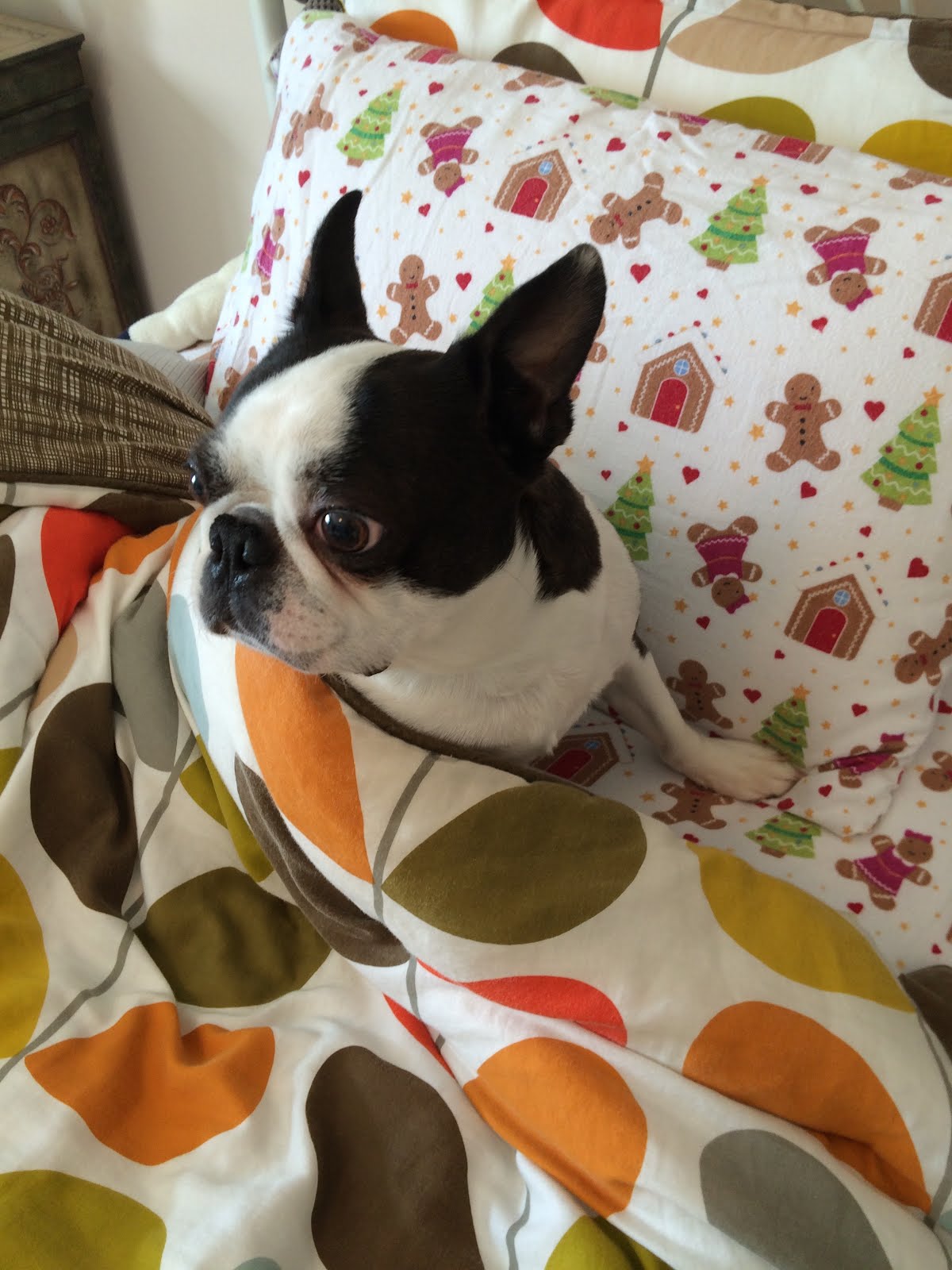
I feel guilty because the life I planned with my boyfriend is now very different. Sometimes I feel like I have very little to offer to the relationship. On paper, I feel like I kind of sound like a lemon. "Free to a good home: 28 year old girl-woman who can't drive, work or breathe on her own (for certain basic activities.) Very expensive special diet. Comes with Boston Terrier that you must also take care of." Hopefully from that line you can tell that I have a sense of humor, which is one of my selling points, beside my really cute dog.

Spencer has stuck by my side through my diagnosis, which I am so grateful for. (But it also has made me feel guilty.) He has so much life a head of him, and I don't want to stop him from following his dreams. This experience has really shown me what is valuable. Through all of this proverbial crap I have become a more supportive and grounded person. However, that doesn't change the fact that I probably won't have biological children. Or the fact that I am not sure if I will be comfortable adopting because a few doctors gave me the life expectancy of a hamster at the start of all this. I worry that my situation will effect what jobs he will want. I don't want him to take the job with benefits over a dream job because of me. I don't want him to have to take a high paying job that he hates because I cannot work. We were supposed to be partners. Equal partners with different strengths and weaknesses to balance each other out. I am strong as hell- but are these new found strengths valuable for "real life?" I feel like I am not apart of real life, but a mere by stander watching from the outside. I know he doesn't view me as an invaluable counterpart, but sometimes I wonder what I truly can contribute to our relationship.

I also feel a lot of internal guilt. At the very beginning of all of this I blamed myself for getting sick.

"I must have done something wrong."
"Healthy people don't get sick."
"Was my diet really that bad?"
"Did I really stress that much more than my peers?"
"What did I do so differently than other people my age that this happened?"
"Am I being punished? Did I get sick because I am a bad person?"

Those are some of the thoughts that I really struggled with. I felt as if that I must have done something wrong to get sick, especially because I was diagnosed with a rare disease. Overtime I have tried to accept that the perfect storm must have been going on in my body that allowed the disease to develop. I didn't do anything to "deserve" this, it just happened.

I believe that holding on to and hoarding negative emotions are not healthy. I have made progress releasing a lot of the guilt that I feel over being sick. Obviously life happens, and the feelings bubble up from time to time. However, it is important to handle those feelings appropriately. I accept that I didn't do anything wrong to get sick. There was probably nothing that I could have done to prevent it from happening.

I also accept that my parents love me so deeply and unconditionally. My parents helping me, taking care of me and going well above and beyond the call of parents of a 28 year old child are all an act of love. I know that them taking care of me, and supporting me isn't even a question, hesitation or thought for them. They want to take care of me. I know that they would want me to feel loved through their actions, and not like a burden.

I also know that Spencer loves me, and rarely sees the disease. He understands that although being sick dictates very important aspects of my life, the disease isn't who I am. He supports me through all of this, and sees who I am truly am- which is why he sees me as an equal and valuable counterpart to the relationship. I know that his companionship is something that he chooses to offer me, and he that this is another act of love.

It has taken me a few years to slowly release all of the guilt, and to slowly accept all of the love that others want to give me. I've learned that being sick isn't the time to start denying yourself love and simple pleasures. For me, it has become a time to indulge in all the good things that I can. For me, I try and find the beauty in every day.

(Please note: I refuse to refer to it as "my disease" or "my illness." I have no ownership over it, and it is not a characteristic or trait.)

Thursday, 10 March 2016

Happy International Nap Day!

Sammy enjoying one of his many daily naps
Happy International Nap Day!

As someone with Pulmonary Hypertension I know how valuable a good nights rest and cat nap can be. I couldn't resist the opportunity to write about the benefits of napping for this special occasion.

I come from a family of troubled sleepers. Getting a good night's rest is something that I have struggled with since my youth. Throwing a sleepless night on top of dealing a chronic condition can feel like the ultimate recipe for disaster. A lot of people with conditions like Pulmonary Hypertension can tire easily because of all the extra work their body is doing to function. Having lower than normal oxygen levels can also be very tiring on the body. I know that when I don't have a good nights sleep I usually have a harder time functioning the next day. Sometimes it feels like I have a flare up of symptoms as well. Other times I can get a great night's sleep and still feel tired.

Along with struggling to get a good night's sleep, I have always tried to avoid naps. When I was younger my mom would try to encourage me to take a nap. I would always say that I didn't need one and try to wiggle my way out of it. My mom, being the smart lady that she is, said that if I didn't fall asleep after resting for 10 minutes that I was allowed to get up. This trick always worked, and I always ended up napping despite believing I didn't need one. This has been a habit that I have recently adopted again as an adult. I will often lay myself down for 10 to 15 minutes. If i don't fall asleep, at least I rested and relaxed. Making time to rest and relax and something precious that has been lost in our society. We often think that if we make time to surf the web or watch TV that we are making time to relax and rest, when that simply isn't the case.

Sometimes I feel like a need a good nap after having a big night the day before. I am always sure to set a timer because napping for too long can actually make you feel worse. The sweet spot for napping is 45 minutes or less. If you nap for more than 45 minutes you might end up feeling more tired. I enjoy 20 minute cat naps because they leave me feeling recharged. Power naps are great if you just need a little rest. It will leave you feeling refreshed (and in a better mood if you are like me and get reeeallllyyy cranky if you are tired!) If you decide that you need a 45 minute nap, you will benefit from going into REM sleep which can aid with creativity.
Casper has created 'Napping 101' to tell you more about the benefits of napping, and how to achieve the perfect nap. I tried to avoid napping after diagnosis. I didn't want to admit that I was tired or that I needed extra sleep, mostly because I didn't want to seem "sick." I felt ashamed of needing naps in my 20's. I have learned though that napping is for people of all ages and abilities. My boyfriend (who is younger than me) naps after playing hockey or having a late Saturday night. Napping is for everyone, regardless of their health situation. In fact, our bodies are designed to want to nap because human survival depended on alertness.

The benefits from napping range from an increase in productivity, to reducing stress and anxiety. The best times for napping are between 1 and 3 p.m. Avoiding napping after 4 p.m as napping too late in the day or evening can interfere with your regular sleep time. Make sure your nap area is a comfy cave with a comfy mattress. I always change into comfy clothes, hop into bed with my teddy bear, eye mask and of course...my supplementary oxygen! If you don't have an eye mask, I would recommend one for napping as it can help block out the sunlight. I also use my eye mask at night. I find it works as a "horse blinder" and encourages me to sleep. As I mentioned in a previous post, a bit of Badger Balm Sleep Balm hits the spot as well! The Sleep Balm has lavender and bergamot oil in it which is super soothing when trying to wind down to sleep.

Please see the Caper 'Napping 101' image below to learn more about the benefits of napping, along some helpful tips on how to become a napping expert!

Happy International Nap Day! Do you have any favorite napping habits? Share in the comments below!

https://casper.com/?country_id=204&utm_source=google&utm_medium=cpc&utm_campaign=S.CA-1-Brand-Exact-Casper&utm_content=Brand-Exact-Casper&utm_term=casper&cvosrc=ppc.google.casper&cvo_campaign=S.CA-1-Brand-Exact-Casper&cvo_crid=102548693896&Matchtype=e&cvo_device=c&cvo_position=1t1&cvo_network=g&cvo_adgroup=22385271856


Sunday, 21 February 2016

Social Media Detox

Looking forward to finding more
zen time with Sammy.
When I was diagnosed with Pulmonary Hypertension I began a journey of wellness. I sought the help of nearly every alternative therapy available to me. Some of the alternative therapies I have tried have been pretty wacky. Others have felt really rewarding because the practitioners helping me supported me so deeply.
In continuation of trying alternative ideas to improve my health, I will be making the transition to  going vegan starting in March. I hope to try it out for a month and see if I notice any changes. I was vegetarian with a limited dairy intake before I was diagnosed, so I am not sure what to expect. I am also going to get a juicer, which I feel pretty excited about! I asked my friends on Facebook to share any tasty vegan recipes they might have with me. This solidified the bigger change that I wanted to make; a social media detox!

Why I Need a Social Media Detox


I started this blog a few months after I was diagnosed. A lot of people with PH reached out to me when I first started the blog and told me that it took them years to get involved in the PH community. I don't think I jumped into creating the blog too soon, but I wasn't prepared for all of what would come with it.
By nature, I am ambivert. I enjoy being social, but on a small-scale with my fellow quiet friends. I also enjoy my alone time and my privacy. I have made some really great friends through social media who I cherish very much. However, it can be a little overwhelming for me to deal with the attention the blog has brought to my personal life. I get daily Facebook adds (often from people that I do not know, and have never interacted with.) I get messages from people that I do not know. "Weird" guys who have some kind of fetish for disabled ladies have also tried to add me to contact me. Cringe. Barf. No thanks. Delete. BLOCK.
My goal of with this blog was to create a sort of "safe space" for people with PH. I realized that it was so sorely needed. I am so grateful for all of the amazing people that I have connected with through this endeavor. I could not have created this without the help of other people, and their willingness to share and discuss aspects of their life. I have also written personal posts and have publicly shared very difficult topics. I eventually rewrote and shared some of these articles on other websites, and was confused by some of the comments I received from strangers. Which leads me to the issues that I have now, and why I so sorely need a social media detox (among with other things!)
I wouldn't say that I am in the public eye, by any means. However, I think there is the assumption that people have the right to be unfiltered with me because I have put myself out there. Perhaps this is a side effect of social media, and it is unavoidable on some levels. I think people forget that I too, am fragile and need support. I am human. I am going through something difficult and challenging on so many levels.

When I first started this project nearly two years ago I was contacted by several PH organization. They did not offer me support even though I was newly diagnosed. Instead, they asked me for help on projects. This blog has given me a lot of great opportunities, but I also think it gives people the perception that I must have everything all figured out. People assume that I am immune to all the emotional and physical complications of PH, when that is simply not the case.

I received a lot of unwarranted advice from both strangers and friends on social media. The “advice” I have received has ranged from birth control (which is sadly, what most took away from xojane article) and my diet to oxygen and my spiritually/religion (or lack there of.) Other people (who do not suffer from a life-threatening illness) have tried to tell me what will “fix me.” I find a lot of this “advice” to be very privileged.

For example, a lot of people not in my situation have told me that they would go on "eat, pray, love" mission if they had PH. Having PH can make it difficult to travel for a variety of reasons that differs from patient to patient. Another issue is that I can't have salt because it can cause heart failure. That is two out of the three components of their asinine idea. Others have made comments on me becoming a parent/adopting saying whether I am too sick to do it, or that I should just do it anyways! I realize that I did write about this topic openly, but I didn't expect people to feel comfortable enough to say whether I was healthy enough or too sick to do something. Some of the comments were very cruel, but it is fine. I knew that this was a high possibility when I began writing on my blog and freelance writing else where.  The issue is that these comments and “advice” have slowly made its way over to my personal social media accounts, the place where I wanted to maintain a sense of normalcy. I have slowly lost my “safe place.”

It is fine if people want to comment on my posts here or my freelance work. I always appreciate the fact that someone took the time to write a comment, regardless of what it is. I want to emphasize that I do want people who read my blog to feel as if they have a friend in me, and that they have my support. I always feel very honored when people take the time to send me an e-mail about an article or blog entry that I wrote. My business e-mail address is always there for anyone who wants to reach out to me about anything, whether it pertains to a freelance writing, or someone has just been diagnosed and is looking for support. I truly, truly, truly want to offer my support to anyone who reaches out to me. I know how lonely and isolating this disease can be, and I have made some of the best friendships with people that I have not met through this blog.

My birthday just passed and I was surprised by how many people mentioned the fact that I was sick in the same breath as wishing me a Happy Birthday. I am sure these people meant well. I do appreciate the birthday wishes that I received, but I think sometimes people need to take a moment before they hit “send.” Did I want to think about having PH on my birthday? No- but sadly there hasn’t been a day yet where it hasn’t consumed me. Do I want people to only view me as someone with PH? No. I am so much more beyond all of this, and have a life and interests beyond it. I happen to have PH, but it isn’t a word that describes me.

So, this brings me to my much-needed social media detox! In March I will try juicing and making the
process of going vegan for a month. I also plan to deactivate Facebook for the month and limit my computer and cell phone use each day. I will still be on Instagram (because there are pictures of cute dogs there...) My hope is that I will have more time to meditate (and to become better at it) each day. I hope having more spare time that is free of distraction will also encourage me to read, write and draw more.

I really just want to live a better life. I feel so disconnected from people sometimes because of technology. How many times do we check our phones during dinner or a conversation? I know I have been guilty of doing this. While social media can be really create for friendships, I think it can also give a false sense of what is important in life. I just need to balance having a life beyond the blog, and hope that my desire to have a personal/private life in addition to the blog can be appreciated.

xo Serena

*Note: The PHight or Flight Project will continue during the month of March. Please be sure to follow me on Twitter for the latest updates, or subscribe to my posts by entering your e-mail in the tool located in the menu to the right. You can also view updates directly on your phone by downloading the phaware app. Click "more" and scroll down to find my blog.

Sunday, 17 January 2016

My Experience: Depression and Pulmonary Hypertension

Facing a serious and potentially life-threatening disease is no easy feat. When I look at my life, it is now divided into two parts. Before diagnosis and post-diagnosis. I am also divided between who I was before this all happened, and who I am now. It has affected every aspect of my life, such as ending my career, to complicating my relationships with not only my partner but my parents and friends.


I was diagnosed with Pulmonary Hypertension at the age of 25, and it completely unraveled me. I had lead my life thinking that I had my whole life ahead of me, only to find out it may end out much sooner than I would have hoped. I was certainly aware that I wasn’t invincible, but being a young adult gives you a false comfort of time. Throughout my youth I was a bit of a loner, and worked very hard to balance a part-time job while attending university. I was preparing for later, for when I thought life would really get good. I was saving up to move out, started my first real career job, dreaming of getting married and thinking about having kids when I found out that I have PH. I feel like I was treating life as a lay-away plan, hoping to enjoy it once I reaped the fruits of my labour. What I really wanted was a simple life, and that is what I was waiting to enjoy. It feels like my diagnosis has taken many of those plans away from me. As you can imagine, it became very difficult to find anything to look forward to.


I have struggled with depression my entire life. I remember being as young as four or five years old the the first time I had dark thoughts. I was a very shy child and also suffered from crippling anxiety. I was often ill as a child and had spent some time in and out of the hospital. I learned in school that being sick and hospitalized often as a child can contribute to depression and other mental disorders later on in life. I began to really struggle with depression as a teenager. I was eventually offered medication from a family doctor. I politely declined, feeling it wasn’t the right choice for me. 


I was very hard on my self, and I never felt I was good enough. I am not sure where this feeling came from because my parents have always been incredibly supportive. I put an unreasonable amount of pressure on myself. Depression affects everyone differently. I had a hard time finding value in myself, or value in the life I was trying to make for myself. I felt like such a loser no matter how hard I tried at things. I felt unlovable and unworthy (even though I had incredible love from the people in my life.)

Unfortunately, I couldn’t see how good my life was for a long time. 

It took the brink of death to help me really appreciate life. This isn’t to say that life after diagnosis is a blessing, or that I no longer struggle with depression. After diagnosis I was recommended medication to treat my depression. I explained to my doctor’s that of course I was depressed, look at the news I had just received. I politely declined medication for treatment for depression once again.


The depression I now faced was paralyzing. I cried before bed and when I woke up, and sometimes I cried throughout the day. I barely spoke or ate. I became withdrawn. It was hard to find a reason to get up most days. That is the weird thing about living with Pulmonary Hypertension. I want to live so badly, but not under the conditions the disease offers to my life.

 I decided that I was tired of wasting my valuable time feeling so terrible- so I started seeing a life coach, and spoke to my alternative health practitioners about my depression.

Living with a life-threatening or chronic condition can understandably place a damper on one’s life. Suddenly it feels like we are in a world we no longer belong in because of accessibility issues, or the need for medical equipment. Sometimes it can be hard to enjoy aspects of life because of the all of the side effects of medications, the new equipment we need to stay alive, the pain we feel, the emotional burden we carry, and whatever else comes along with a disease.


I found myself having a hard time knowing who I was anymore. The disease weighed so heavily on my self-esteem. Suddenly, I felt and looked like a different person and it wasn’t a version of myself I liked. I would cry sometimes looking in the mirror, seeing how frail I looked, and having a nasal cannual attached to my face made me self-conscious. Prior to PH I knew who I was, and I had already created and obtained my own identity. After diagnosis I had to figure all of that out again. I am still trying to figure out who I am (and who I can be) now.


Unfortunately, there is still a stigma around mental illness and chronic conditions (like PH.) To the naked eye people with depression, PH, or both, can look ‘fine.’ A lot of symptoms are chalked up to being in our head, or easily fixable (which is often not the case.) What outsiders fail to realize is that we would much prefer not to have these problems. I didn’t decide to have Pulmonary Hypertension, but life had other plans.

 If I had my way, I would have preferred to have a life less complicated by disease.

I hope that this can bring light to the fact that depression, and other mental illnesses like Post Traumatic Stress Disorder (PTSD,) are very common among people within the Pulmonary Hypertension, (and chronic illness) community. We are constantly exposed to triggering environments. Such as the hospital, where routine tests are often performed. This environment, the treatments and the tests are often associated with negative memories and experience. I experience vivid nightmares where I wake up because of the sound of my scream, covered in sweat.  I also have panic attacks when I have to go back to the hospital where I was diagnosed. They left me in a wheel chair facing the wall while I cried.  This hall way is where I used to do a walk test. Needless to say it was hard to get good results when all I was reliving the worst experience of my life. Luckily, these nightmares and attacks rarely happen anymore- but of course I still struggle. It would be very difficult to go through many of the experiences of having a life-threatening illness and come out of unscathed.


If you are struggling, please do not be ashamed to find the right treatment for you. There are lots of ways to seek treatment. Talk to a doctor, family member or friend that you trust. When finding professional treatment, do not settle. Find someone who you have a connection with, someone who you trust and helps you feel a little safer. There are not only doctors you can talk to, but psychologists, social workers, life coaches, alternative health practitioners and so on. These qualified specialists can help discuss various treatment options with you as well, and help you develop coping skills.


Ironically enough, my depression is probably the best it has ever been in my entire life. I have found a regimen for myself that works well for me. I practice different alternative therapies along with meditation and yoga. I know that I am human and still allow myself a few days if needed to be sad. This usually happens after a PH appointment. It is very difficult to get used to, but I try very hard to live in the current moment. Even though things may suck (for lack of a better word,) there are still things around me that I can enjoy. There are also many things that I am grateful for. This experience has really taught me to appreciate things more, including myself. When I was first diagnosed I thought I shouldn't enjoy things until I got "better." Now I have learned to try and enjoy things while I can.

My life isn't perfect, or what I had hoped it would be. However, my quality of life was so bad before that it has helped me appreciate my health now. Sometimes I get caught up thinking about the future, which can be pretty scary. It is human to be scared, but you have to be able to find the right balance. I give myself a few days to deal with the grief, but try to let deal with my emotions and let them go. What I am going through isn’t easy, so I have learned to be more patient and kind with myself. This has also helped me learn how to be more compassionate towards others.  I am no longer hard on myself. I have also learned how to love myself, which I desperately needed to do in order to take care of myself and truly love those around me.


I hope that this can encourage anyone who is struggling to reach out. Please know that you are not alone. Reach out to someone you love and trust, and find the best treatment plan for you. Don't be afraid to speak up about how you are feeling, and be kind enough to yourself to find help.

xo Serena

Wednesday, 6 January 2016

How to Support a Friend with an Illness

Being a friend to someone with an illness like Pulmonary Hypertension doesn't come with a set of instructions. I recognize that as a young adult it can be challenging to try and support someone through an illness like PH, cancer, MS or even depression. It can be hard to know what to say, what to do, or to emotionally handle it.

I know first hand how difficult it can be for some people to maintain a relationship with someone post diagnosis. Some friends and family members stopped talking to me after I was diagnosed. Some have admitted that it was too difficult for them to support me, and that they had no idea what to say to me. At first I found their honesty frustrating. They had just assumed that it was too hard without even trying to talk to me once post diagnosis. As a young adult, I understand that other people my age may not have the experience or wisdom yet to know how to best support a friend with an illness. Even elders can lack this wisdom. The special kind of compassion and patience it can take to support a friend through a journey like this is not universally taught.

I recognize the unique set of challenges that supporting a friend with an illness can entail. I wanted to share what I have observed through my own challenges in the chance it can help provide insight to anyone else in a similar situation. It is okay not to know what to do or say sometimes. Illness can be a very difficult thing to face.

1. It is Okay to Just Listen


I have recently learned that I have been very guilty of making this mistake. I have a friend who struggles with mental illness, and we often discuss what we are both going through. Because I want to help, I have tried to offer advice in the past. It took sometime, but I have finally learned that sometimes it is okay to stay silent and just listen. Listening is often the best way to support someone. Your friend may not be looking for advice, but just someone to share their ups and downs with. Sometimes advice, even given with the best of intentions, can be counter productive. A solution that may work best for me may not be something that works for my friend. If you find yourself stuck in a situation where you have no idea what to say, it is possible that you are in a situation where it is best just to listen and offer your support. I think it is in most of our human nature to want to make things better. We desperately try to think of words and advice to help make things better. Unfortunately, there are certain situations where words simply fail.

I have had 'healthy' people try and give me advice in an effort to help. Even with the best of intentions, their advice is often impractical for my situation. As you can imagine, it can be a little silly to get advice about being disabled from someone who is healthy, works full-time and can go up a flight of stairs without getting short of breath. I remember a lot of friends and family trying to comfort me during my lowest of lows after I was diagnosed and was on oxygen nearly 24/7 for over a year. To say I was depressed feels like an understatement. In an effort to comfort me, many friends told me how they would backpack across the world if they found out they had a life-threatening condition and how I should see the world while I could. That is an absolutely lovely idea, but it is also unrealistic for a lot of people facing life-threatening illness. If you can't climb a set of stairs, how would you backpack across the world?

2. "That Sucks!"


This is very intertwined with tip number one. I think having a positive attitude can help alleviate some of the suffering that we are in control of. However, I don't think it would be human to try and ignore other feelings like sadness, disappear and disappointment when set backs happen. I also think that it is important for the person who is facing an illness (like Pulmonary Hypertension) to try and find the bright side in situations for themselves.

When another person tries to point out the bright side it can sometimes feel like their struggles are being undermined.
Again, I think it is human nature to want to help and trying to find the positive can feel like the right thing to do. It can be a good way to stay positive, but it is important to know when it is okay to be positive and when it is okay to be realistic. A friend or family member certainly goes through these struggles and set backs with their loved one who has an illness, but their struggles are different than the person with the illness. It can seem easier for a 'healthy' person to try and point out the positives in a negative situation because they usually cannot relate to what is physically going on. When things suck, it is okay to admit that things suck! It is totally okay to agree with your friend about their day or situation sucking.


Being positive, and looking for the bright side isn't a bad thing but be sure to be mindful of the situation. For example, pregnancy for women with PH is strongly advised against. It is very unlikely that I will have children of my own because pregnancy for women with PH has a high mortality rate. Sometimes, in an effort to be supportive, my family will say "you never know- maybe someday." I would rather have them agree that the situation sucks like my good friends Beavis and Butthead. Having them say that it is still possible, when it isn't, sort of feels like they aren't on the same page as me which I need in order to have their support. If they still think something is possible when it isn't, they cannot understand my loss.

3. Neutral Ground Hotel

If you got this reference we should be best friends. If you didn't, lets just pretend number three is just called "Neutral Ground." This may seem really obvious to some, but you can still talk to your friend the way you did before their diagnosis.

What did you used to talk about? The Bachelor? (I think Cailia is going to win.) Making a Murderer? (I am two episodes in- don't tell me anything!) You can certainly still talk about those things. Those are your interests that you probably bonded over together in the first place. I don't always talk about being sick, nor do I want to. I have only certain people that I talk about it with or share so much with.
Talking about things too much can also make it more difficult to get over what is happening, and can make me relive a bad event too many times. Sometimes I want a nice distraction! I want to go out with my friends and have a good time. For me, this means that I enjoy their company and we talk about the things we used to and have a good laugh. (A good cry is okay too!)

A lot of things can change after diagnosis. I know that I have changed, but I still really appreciate and value catching up with a good friend over a cup of tea. It is something I did before that I can still do, and really enjoy! You can still enjoy parts of your friendship that you used to have, and still have.

4. Put Oxygen on Yourself First


I have only been on an airplane twice in my life. Once to go to Montreal, once more to fly back home. (I watched Lost too many times and cried during take off, but I felt like a bad ass flying home by myself.)

It turns out flight attendants don't actually give you instructions anymore on how to survive a catastrophic event on an airplane. Instead, you watch a movie. I learned that if you want to survive a crash, you must put an oxygen mask on yourself before you can help anyone else. If you run out of oxygen, you won't be able to help other people. This might feel like the most challenging step for a lot of people, but at the end of the day everyone needs to practice self love and care for themselves.

Supporting someone through a difficult situation like illness can be very challenging. It takes very selfless, caring and special people to hold our hands through these hard times. Sometimes people feel selfish for having their own needs, and try avoid tending to them. However, you need to take care of yourself in order to take care of others and to keep yourself well. Don't be afraid to take a time out and have a bubble bath, or whatever else you may do that makes you fee good. It might be a lot on you emotionally to support a friend with an illness, and that is understandable. Be sure to acknowledge and tend to your own feelings as well.

As a friend of someone with an illness, you may have your own set of challenges. Do not be afraid to talk about about your own challenges with your friends. Friendship goes both ways, and often times we want to be there to be support you as well. I like being able to support my friends because I like helping others, and feeling as if they can still rely on me. Your challenges may be different than ours, and that is okay too. Life happens differently to everyone.

Thanks for reading, and thank you for all my good friends and family members who support me.

xo Serena

"If you have a loved one who suffers, you can be a compassionate ally for him... Play the role of a bell of mindfulness.
Your squeezing the hand is like a bell, lovingly calling your friend to come back to himself. That squeeze means, 'I am here for you. You don't need to do anything but breathe.'"
 
— Thich Nhat Hanh, No Mud, No Lotus, p. 42.

Wednesday, 23 December 2015

Preparing for the Holidays

Spencer telling me Star Wars spoilers
Hello everyone! Sorry I haven’t written any posts or had any PHight Fridays in a while. I hope to have more PHighter Friday stories in the New Year to share with all of you. If you are interested in writing for a PHighter Friday please send me a shout at phightagaisntph@gmail.com. From there I would be happy to send some examples, along with various questions to help with the writing process.

As the holidays approach I thought it might be nice to do a little post about how to prepare for the holidays. I know that although the holidays are supposed to be a happy to time, sometimes the holidays can be difficult for a handful of reasons. I was diagnosed with Pulmonary Hypertension a few days before Christmas, and I had my RHT on Christmas Eve. Needles to say I feel my emotional roller coaster go up and down a lot during the holidays. The holidays can also be physically demanding (even for people without a chronic or life-threatening illness!)


Here are four suggestions to help prepare you for the holidays;

1. Get a Good Night’s Sleep

Many people with PH (and other conditions) can feel worn out and tired more easily than the average bear. The holidays can be an exciting but also a very busy time. It is important to try and reserve your energy wisely.

The first step in keeping a good amount of ‘gas in your tank’ would be to get a good night’s sleep before an event, like New Years or any other holiday gatherings.

Here are a few quick tips to getting better sleep;

-To ensure you have a goodnight’s I would recommend turning off electronics (like your phone) 20 minutes to an hour before you want to sleep. The light omitted from many electronics can trick your brain into thinking it is daytime, thus making it difficult to fall asleep.
- Try to do something relaxing 20 minutes before bed. This will help clear your mind of unnecessary clutter and thoughts. What do you find relaxing? Some people prefer doing a bedtime/relaxing yoga routine before bed (you can find some for free on Youtube.com and Pinterest.) There are also various meditations and soothing noises for sleep that can help you drift off. Here is a list of some of the best-rated apps to help with sleep.
- Scents can be very soothing, which is perfect for helping you feel relaxed enough to get a good night’s sleep. Lavender is one of the mostly largely accepted scents associated with relaxing and a good night’s sleep. If aromatherapy and diffusers aren’t your thing I would highly recommend Badger Balm’s Sleep Balm. It is made out of essential oils, but comes in a wax rub form instead of a liquid. It isn’t messy, it is very easy to use, and it only involves one step. I rub a little bit on my temples when I hop into bed. I absolutely love the smell of lavender and bergamot in the Sleep Balm. (I am getting sleepy just thinking of it.)
- Read a few pages or a small chapter of a good book before bed.

- Don’t be afraid to nap for 20-40 minutes the day of an important outing!

2. Take Care of Yourself

Preparing for Christmas Eve by slothing around
Remember to take care of yourself. If you are not feeling up to something, ask if you can reschedule. Chances are everyone would feel happier knowing that you felt well enough to enjoy something more than you would have if you were tired, in pain, not feeling well etc. I know that many of us struggle with the associated risk of ‘cancelling’ plans but sometimes things are beyond our control. This is why it is so important to put yourself first. Good friends and family will understand. They would want you to tell them how you are really feel and what would be best for your situation.

Don’t hesitate to ask for help, or to let others know how to make a situation easier for you. Don’t be afraid to need to relax before, during or after an event. Don’t be afraid to take a day to recoup after a gathering. Take a sloth day. Stay in comfy and cozy clothes, cuddle up with a cup of tea and your favorite human, or animal (real or stuffed.) Have a bath, marathon a TV show, read a good book, draw, surf the web, meditate. Just relax if you need to (and don’t feel guilty about it!) PH or not, everyone is entitled to a good sloth day after dealing with all the business that the holidays can bring.

3. Eat Right

One year in high school my friend Aileen gave up sweets for lent. I vividly remember saying “what good is life without dessert?” A little dramatic, I know. I certainly eat better than I did in high school
(I am on a gluten-free diet, and try to eat mostly healthy goodies,) but I maintain the idea for myself that everyone needs a good treat everyone once in a while. My only advice is to pick and choose your dessert wisely. Make sure to indulge in something that you will really enjoy. At the end of the day, I don’t think I will regret any of the cupcakes that I have eaten. I thought about it more, I won't.

My favorite special treat are the cupcakes from Kelly’s Bake Shoppe in Burlington, Ontario. My poor boyfriend has to drive me all the way to Kelly’s on the regular. The cupcakes at Kelly’s (which I swear by) are not only gluten-free, but also vegan and made in a nut free facility. Kelly’s also uses whole ingredients along with organic and fair-trade ingredients. Even better than that, their cupcakes (along with donuts, cookies, muffins...) taste amazing. My boyfriend is a little on the picky side when it comes to my venture into healthier food, and he loves them! They are unlike any vegan/gluten-free cupcake you have probably ever tried. They are not good for ‘gluten free’ or ‘vegan’ cupcakes (which can be dry, or have a funny texture.)  They are just good. Okay- I rambled too long on this one. I really like Kelly’s. I think I should go before New Years to get some cupcakes for my celebrations.
Enjoying a cupcake at Kelly's

*Fun tip: their cupcakes freeze very well. Freeze some and keep them on stand by for a rainy day. I always treat myself to one after a PH appointment.


A very serious issue in terms of PH and dietary needs is maintaining a low sodium diet. People with PH are advised to have a low sodium diet because salt can cause water retention. This is a problem for people with PH because the volume of blood your heart has to pump increases when too much water is stored in your tissue. Hearts with PH are generally working overtime, which is why a low sodium diet is so important.

If you are going over for dinner at someone's house, make sure to let them know about your low sodium diet. I know that this is a pain the butt, so I will often ask if I should bring a meal for myself, or come over for dessert. You can always eat a meal before going over and have some salad with low/no sodium dressing while at your family or friend’s house. This way you’re not missing out on any bonding over dinner. Don't be afraid to bring your own condiments or whatever you need to ensure you have a meal that is safe for you.

If you are going out to a restaurant for dinner, be sure to let your server know that you cannot have salt on your meal. When I go out to eat I explain that I cannot have salt due to a very serious heart issue. I have to say this because I look healthy, and because of this, servers and chefs have not always taken my request seriously. This has resulted in a few episodes where it feels as if my heart is trying to self destruct. Not fun. Be sure to ask what the chef would recommend for your request. Some places will be happy to make something off menu for you. Your best bet is to get a protein that isn’t seasoned a head of time, along with veggies. Ask for pre-made sauces with salt to be served on the side. This way you will have better portion control for how much salt you do have.

Salt is hidden in tons of things from butter to broth. If you are making your own meal, look for low to no sodium products. Stay clear of recipes that ask you to use a lot pre-packaged items. An example of this would be a curry recipe that calls for you to use a pre-made jar of curry sauce for butter chicken. Look for a recipe that will actually ask you and instruct you on how to make the curry sauce. You can alter any recipe as needed. Omit the salt completely and add low to no sodium products that the recipe calls for.

If you find that your meal is a little bland Mrs. Dash offers salt free seasonings and marinades. (Southwest is my favorite seasoning. I put it on corn or potatoes with a bit of organic butter.) Another company called Mr. Spice creates organic, no sodium marinade and sauce. Their sauces are so flavorful you probably wouldn’t guess that they don't have sodium! I was very happy to find their products; they have been a total life saver for me. (Some of my favorites from Mr. Spice are the Honey BQQ sauce, and the Hot Wing sauce.)

4. Have Fun

Sammy posing in his Christmas
sweater.
This is one of the most important steps- have fun this holiday season! As I have mentioned before, I know how hard the holidays can be when you have something as serious as PH. It affects everyone so differently. We all have different abilities, and perhaps issues. This is my third Christmas since being diagnosed, and I am looking forward to (hopefully) having my best Christmas and New Years since diagnosis. I know that I am very fortunate to improve the amount that I have, and to have the energy level that I have. Things aren’t perfect, and things can be really hard- but I want to take advantage of good things when and while I can.

I have learned through this experience how important it is to utilize my good days. I’m going to say yes to opportunities that I feel well enough for, and want to do. I will also say no thanks to anything that sounds like it might be too physically or emotionally demanding (or that I just don’t want to.) Remember, it is okay to take care of yourself. Sometimes that means saying no to some invites. Your true friends will understand if you explain the situation to them.

If the moment approaches and you are feeling up for it, celebrate! Have fun, laugh, take pictures and make good memories. If you can’t stay up till mid-night on New Years have your own count down. Celebrate in your comfy clothes, or dress up. Stay in or go out. Do whatever feels best for you, and will bring you the most joy. Kiss your dog, partner, teddy bear or even a consenting stranger at a party for the countdown.

Wishing you all a very safe and happy 2016.

Serena xo

See some of my holiday fun on Instagram