Wednesday, 30 March 2016

Cross-posted: When a Doctor Said 'Hope Won't Help' My Chronic Illness'

An article I wrote is up on The Mighty​ today. Below is a clip of the article. Please feel free to read more at the source.

"The day that I was diagnosed with pulmonary hypertension, a doctor waltzed into the room and announced that I had five, maybe 10 years left to live. He had spoken to my parents first about the news. I looked over at my parents to gauge their reaction. Was this really happening? My mama said very strongly, “It will be OK, because we have hope, and we will get through this.” The doctor seemed almost angry by what my mama said. He nearly cut her off to say, “This isn’t cancer. Hope won’t help you.” That was pretty much the end of the conversation. Well… actually, it wasn’t.

I was going to leave this part out, but it didn’t feel authentic. After what the doctor said I threatened to end my life. If hope couldn’t help me… if there was no hope for me, how could I possibly face each day? I was instructed to go have more blood work and go home after my parents convinced the doctor I would be safer at home with them than at their ward. It was a few days before Christmas. None of this felt like the movies."

Please follow the link below to read more:

Friday, 18 March 2016

The Side Effect That I Wasn't Warned About

"oh brother"
When you are first diagnosed with something, you are usually warned about side effects. Upon the diagnosis of Idiopathic Arterial Pulmonary Hypertension I was warned about side effects of the disease and side effects of the medication. PH can cause a variety of symptoms, or side effects, such has shortness of breath, chest pain, swelling, and heart failure. Some of side effects of some of the medications I take? Liver failure, cancer, anemia, low blood pressure (in all the wrong places,) head aches, stuffy nose. General malaise is probably a side effect of both the medications and the PH- and maybe life. I was prepared for all of that, but then something else set in.

Guilt.

I have suffered from both external and internal guilt as a side effect of PH. I feel such incredible guilt, although the feeling has faded as the years have gone by. I sometimes still find myself plagued by it. It is difficult to see how such a catastrophic that I had such little control over runs down hill. It effects so many other parts of my world.

I feel guilty because my life isn't the only life effected by all of this. Sometimes I find myself saying "sorry, I am sick." Apologizing for something that I have very little control of. Saying sorry, even though I know these situations will happen again. Unable to work, I still live at home and rely on my parents. I am sure they planned to retire soon, and I feel like I messed up their golden years because my golden years currently overlap with theirs.

Me living at home is also expensive for my parents. There are obvious medical costs, plus my crazy expensive food (because I eat mostly fresh and organic foods.) I see how my side effects so deeply impact them in various ways from socially to their well being. I hate that something that happened randomly hurts us all so deeply. I try to handle this human experience as graciously as possible, but it isn't always possible to sugar coat things. A positive attitude will help get you through the day, but it won't change the fact that I struggle going up a flight of stairs. I also think that you have to admit when things suck. It wouldn't be healthy to ignore your challenges, or to try and dress up a wolf as unicorn and hope that it doesn't eat you.

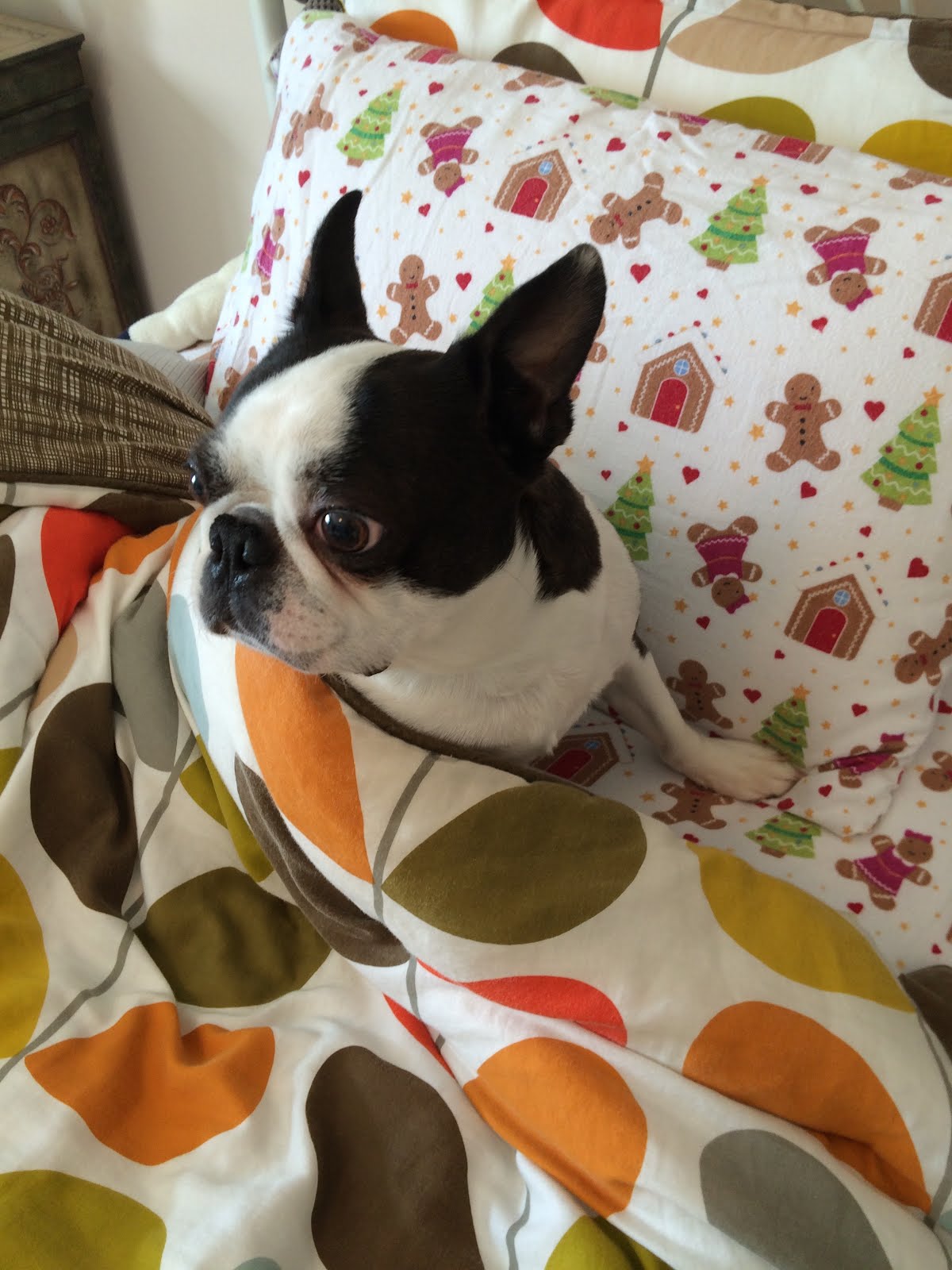
I feel guilty because the life I planned with my boyfriend is now very different. Sometimes I feel like I have very little to offer to the relationship. On paper, I feel like I kind of sound like a lemon. "Free to a good home: 28 year old girl-woman who can't drive, work or breathe on her own (for certain basic activities.) Very expensive special diet. Comes with Boston Terrier that you must also take care of." Hopefully from that line you can tell that I have a sense of humor, which is one of my selling points, beside my really cute dog.

Spencer has stuck by my side through my diagnosis, which I am so grateful for. (But it also has made me feel guilty.) He has so much life a head of him, and I don't want to stop him from following his dreams. This experience has really shown me what is valuable. Through all of this proverbial crap I have become a more supportive and grounded person. However, that doesn't change the fact that I probably won't have biological children. Or the fact that I am not sure if I will be comfortable adopting because a few doctors gave me the life expectancy of a hamster at the start of all this. I worry that my situation will effect what jobs he will want. I don't want him to take the job with benefits over a dream job because of me. I don't want him to have to take a high paying job that he hates because I cannot work. We were supposed to be partners. Equal partners with different strengths and weaknesses to balance each other out. I am strong as hell- but are these new found strengths valuable for "real life?" I feel like I am not apart of real life, but a mere by stander watching from the outside. I know he doesn't view me as an invaluable counterpart, but sometimes I wonder what I truly can contribute to our relationship.

I also feel a lot of internal guilt. At the very beginning of all of this I blamed myself for getting sick.

"I must have done something wrong."
"Healthy people don't get sick."
"Was my diet really that bad?"
"Did I really stress that much more than my peers?"
"What did I do so differently than other people my age that this happened?"
"Am I being punished? Did I get sick because I am a bad person?"

Those are some of the thoughts that I really struggled with. I felt as if that I must have done something wrong to get sick, especially because I was diagnosed with a rare disease. Overtime I have tried to accept that the perfect storm must have been going on in my body that allowed the disease to develop. I didn't do anything to "deserve" this, it just happened.

I believe that holding on to and hoarding negative emotions are not healthy. I have made progress releasing a lot of the guilt that I feel over being sick. Obviously life happens, and the feelings bubble up from time to time. However, it is important to handle those feelings appropriately. I accept that I didn't do anything wrong to get sick. There was probably nothing that I could have done to prevent it from happening.

I also accept that my parents love me so deeply and unconditionally. My parents helping me, taking care of me and going well above and beyond the call of parents of a 28 year old child are all an act of love. I know that them taking care of me, and supporting me isn't even a question, hesitation or thought for them. They want to take care of me. I know that they would want me to feel loved through their actions, and not like a burden.

I also know that Spencer loves me, and rarely sees the disease. He understands that although being sick dictates very important aspects of my life, the disease isn't who I am. He supports me through all of this, and sees who I am truly am- which is why he sees me as an equal and valuable counterpart to the relationship. I know that his companionship is something that he chooses to offer me, and he that this is another act of love.

It has taken me a few years to slowly release all of the guilt, and to slowly accept all of the love that others want to give me. I've learned that being sick isn't the time to start denying yourself love and simple pleasures. For me, it has become a time to indulge in all the good things that I can. For me, I try and find the beauty in every day.

(Please note: I refuse to refer to it as "my disease" or "my illness." I have no ownership over it, and it is not a characteristic or trait.)

Thursday, 10 March 2016

Happy International Nap Day!

Sammy enjoying one of his many daily naps
Happy International Nap Day!

As someone with Pulmonary Hypertension I know how valuable a good nights rest and cat nap can be. I couldn't resist the opportunity to write about the benefits of napping for this special occasion.

I come from a family of troubled sleepers. Getting a good night's rest is something that I have struggled with since my youth. Throwing a sleepless night on top of dealing a chronic condition can feel like the ultimate recipe for disaster. A lot of people with conditions like Pulmonary Hypertension can tire easily because of all the extra work their body is doing to function. Having lower than normal oxygen levels can also be very tiring on the body. I know that when I don't have a good nights sleep I usually have a harder time functioning the next day. Sometimes it feels like I have a flare up of symptoms as well. Other times I can get a great night's sleep and still feel tired.

Along with struggling to get a good night's sleep, I have always tried to avoid naps. When I was younger my mom would try to encourage me to take a nap. I would always say that I didn't need one and try to wiggle my way out of it. My mom, being the smart lady that she is, said that if I didn't fall asleep after resting for 10 minutes that I was allowed to get up. This trick always worked, and I always ended up napping despite believing I didn't need one. This has been a habit that I have recently adopted again as an adult. I will often lay myself down for 10 to 15 minutes. If i don't fall asleep, at least I rested and relaxed. Making time to rest and relax and something precious that has been lost in our society. We often think that if we make time to surf the web or watch TV that we are making time to relax and rest, when that simply isn't the case.

Sometimes I feel like a need a good nap after having a big night the day before. I am always sure to set a timer because napping for too long can actually make you feel worse. The sweet spot for napping is 45 minutes or less. If you nap for more than 45 minutes you might end up feeling more tired. I enjoy 20 minute cat naps because they leave me feeling recharged. Power naps are great if you just need a little rest. It will leave you feeling refreshed (and in a better mood if you are like me and get reeeallllyyy cranky if you are tired!) If you decide that you need a 45 minute nap, you will benefit from going into REM sleep which can aid with creativity.
Casper has created 'Napping 101' to tell you more about the benefits of napping, and how to achieve the perfect nap. I tried to avoid napping after diagnosis. I didn't want to admit that I was tired or that I needed extra sleep, mostly because I didn't want to seem "sick." I felt ashamed of needing naps in my 20's. I have learned though that napping is for people of all ages and abilities. My boyfriend (who is younger than me) naps after playing hockey or having a late Saturday night. Napping is for everyone, regardless of their health situation. In fact, our bodies are designed to want to nap because human survival depended on alertness.

The benefits from napping range from an increase in productivity, to reducing stress and anxiety. The best times for napping are between 1 and 3 p.m. Avoiding napping after 4 p.m as napping too late in the day or evening can interfere with your regular sleep time. Make sure your nap area is a comfy cave with a comfy mattress. I always change into comfy clothes, hop into bed with my teddy bear, eye mask and of course...my supplementary oxygen! If you don't have an eye mask, I would recommend one for napping as it can help block out the sunlight. I also use my eye mask at night. I find it works as a "horse blinder" and encourages me to sleep. As I mentioned in a previous post, a bit of Badger Balm Sleep Balm hits the spot as well! The Sleep Balm has lavender and bergamot oil in it which is super soothing when trying to wind down to sleep.

Please see the Caper 'Napping 101' image below to learn more about the benefits of napping, along some helpful tips on how to become a napping expert!

Happy International Nap Day! Do you have any favorite napping habits? Share in the comments below!

https://casper.com/?country_id=204&utm_source=google&utm_medium=cpc&utm_campaign=S.CA-1-Brand-Exact-Casper&utm_content=Brand-Exact-Casper&utm_term=casper&cvosrc=ppc.google.casper&cvo_campaign=S.CA-1-Brand-Exact-Casper&cvo_crid=102548693896&Matchtype=e&cvo_device=c&cvo_position=1t1&cvo_network=g&cvo_adgroup=22385271856


Thursday, 3 March 2016

Accessibility of PAH Therapies in Canada: Part III
 - Patient Testimonials

Part III: Testimonials From PH Patients Who Are On A Treatment Not Available or Accessible in Canada


This is the third and final part of the series. The first part of the series, Access to Opsumit in Canada can be found here. The second part of the series about Treatments That Are Not Available in Canada Can Be found here.

Below are testimonials from PH patients in the US who are on inhaled PH medications that are not available in Canada. These testimonials are unpaid, and are shared by fellow PH patients in an effort to show the positive effect these medications can have for some PH patients.


"I started Tyvaso on the trial in November of 2004 at UCSD medical center. I was asked to go on the trial due to my high numbers.  I was diagnosed in April of 2004.  My mean pressure in my heart during right heart catheter was 96(normal is between 15 and 25).  I had gone years with a misdiagnosis of severe asthma.  I went in for another right heart cath to start the trial.  My numbers had come down, good news to 56 with the use of a medication called Tracleer.  While on the operating table, I took my first puffs of Tyvaso, I took nine.  I was the first patient ever to take nine puffs of the medication.  My mean pressure dropped from 56 to 46.  It was really a miracle for me.  At the end of the study my pressure was 35.  Darn right near normal.  Sadly though, I had to quit the Tracleer and start on Revatio due to liver problems.  But I have been on Tyvaso since starting.

I started going downhill a little November of 2013, I was needing evening O2, and usually I need only at night time.  At this time I was on Revatio and Tyvaso.  I had another dreaded right heart cath in March of 2014.  My doctor was happy with my pressure of 50.  But I was not.  My husband and I pressured him to add another medicine.  He decided to add opsumit, since I did so well on the tracleer and it is very closely related to tracleer without the liver complications we decided to give it a shot.  Fast forward to June of 2015.  I had an ECHOcardiogram.  I asked my doctor my "estimated" pressure as it is not as thorough as a right heart cath.  He said 29.  Wow...almost normal.  I have been feeling pretty good these days.  I am very reactionary.  I have good days and bad.  Without these medications I would for sure be in pretty bad shape of worse dead.  I have 3 adult children and a husband.  A grandson.  Also, raising my niece and nephew, ages 15 and 12."
- Julie, 48 years old
San Diego, California, USA


"I started the inhaled therapy, Treprostinil (Tyvaso), in 2011 after going back and forth with my doctors about IV therapy since my pressures were high and my physical activity was low.  They decided to try me on Tyvaso just to see how I would respond on it.  At first it was a bit difficult to fall into a routine of breathing on a nebulizer every 4 hours, but I wasn't too concerned after I started to feel better.  Before Tyvaso, I'd have a very hard time doing the simplest daily tasks like making my bed, or even showering, without getting short of breath.  Now after almost 5 years on Tyvaso, I'm able to exercise, walk long distances, go on bike rides, almost anything and everything that I wasn't able to do b efore the medication.  It has also improved my 6-minute walk test results, as well as my echocardiogram results.  Tyvaso, in conjunction with my oral medication, has improved my quality of life tremendously and I'm so grateful to have the therapy available to me."
-Reinee
Bay Area, California, USA


"In 2009 I was diagnosed with Familial Pulmonary Hypertension. At that time I was put on two different treatments. One was a long established drug Tracleer, and the other was an inhaler that had been FDA approved only months prior, Tyvaso. The doctor has switched my pill form of medication, but Tyvaso remains my main treatment. I always credit Tyvaso as saving my life. Before diagnosis I was not able to walk up a flight of stairs without getting out of breath, now I can go hiking and jogging. I can breathe easier with Tyvaso, if I am without it for a day I can feel the difference in my chest and my exercise capacity is diminished. "
- Raeana Rader, 28 years old
USA


"I was diagnosed with pulmonary hypertension after I passed out while walking into work. That
was simply too much exertion for my body. I was placed on I.V. Veletri and two oral medications. They got my symptoms under control but I had terrible side effects from the Velerti. The nausea, vomiting, diarrhea and headaches were the worst. I eventually improved so much that my doctor let me do a conversion from Veletri to Tyvaso. Tyvaso gave me my quality of life back. The only side effect I have with Tyvaso is flushing. I feel like a normal human being again. Because I am no longer on Veletri, I can take my kids swimming and no longer have to sit on the sidelines. I am able to exercise on an elliptical for an hour at a time and I have recently started taking a spin class. Tyvaso is also much cheaper than Veletri and because it is noninvasive, I do not have to worry about line infections which could be costly and detrimental to my health. I feel very blessed and grateful to have Tyvaso available to me."
- Ashley, USA

Friday, 26 February 2016

PHighter Friday: Meredith

In February 2015, I received a diagnosis that I long feared.   I was diagnosed with Pulmonary Arterial Hypertension.

At a Blue Lips Foundation's kickoff event
I was 12 years old when I lost my Mother, Bonita, to the same disease.  In 1992, little was known about PH.  The first FDA approved therapy was more than 2 years away.  It was just as common to be diagnosed with the disease upon autopsy as alive.  My Mom was admitted to the hospital on a Wednesday after fainting at a grocery store.  She died the following Monday.  An autopsy revealed she died from right heart failure associated with primary PH.  I was devastated. I no longer had my mother’s guiding hand and heart to lead me through my life’s journey. My mom was 31 years old when she passed away – far too young – to lose her.  To lose her to a disease I had never heard of, and didn’t understand, was unfair and cruel to a young girl.

As I grew older, I dug into PH.  I needed to know how someone so young and vibrant like my Mom could unexpectedly succumb to a disease so unknown and misunderstood.  I researched the disease religiously throughout my high school and college years.  I often wrote research papers on PH.  I allowed myself to wander whether one day I too would be struck by PH.  And then it happened.

In February 2015 I was 8 months post-delivery of my second child.  Following his birth, I was eager to return to the gym, my normal workout and diet routine, and get back to “me.”  The moment I was released by my doctors, I re-started my high intensity workout routine.  I suffered mightily during the cardio segments of my workouts. I experienced extreme fatigue, shortness of breath, dizziness, and nausea – all classic signs of PH.  For months I chalked it up to the “baby.”  By February 2015, however, I could no longer ignore what my body was telling me.  I knew from the years I spent researching PH that the disease may have a heredity component.  I also knew the symptoms I was experiencing were signs of PH progressing throughout my body. 

I will never forget the moment I could no longer ignore my reality.  I awoke in the middle of night to cries from our young son.  I went to his room to rock him.  When I returned to bed, my heart was pounding out of my chest.  I could feel the beats travel up through my neck and down my arm.  My chest was beating so hard and so fast that I felt as though my heart was going to explode out of my chest.  I knew I needed to see a doctor immediately – and I was terrified of what I would hear.
I was placed under a battery of tests to rule out a heart attack and heart disease.  The doctors were pleased when those tests returned negative.  Instead of joy, I was attempting to prepare to hear news I had long feared.

I told the physicians about my family history. Within three days of my initial ER visit, I underwent an echocardiogram.  The cardiologist called my husband and advised him of the results – confirming to him that my heart was grossly enlarged and that a consultation with a pulmonologist was needed immediately.  We were then told the news – “you suffer from pulmonary arterial hypertension.”
My world stopped right then and there.  23 years of fear, agony and prayer for a better result all crashed together from those six words.  I was devastated. I instantly thought of my Mom, my two young boys, my husband and all those people I care desperately about.  I remembered losing my Mom at such a young age, and I didn’t know how to cope with the prospects my boys not having me.  I was inconsolable. 

While my universe was spinning, my husband and doctor immediately began to discuss treatment options.  What I didn’t realize at the time was that I was diagnosed as a Class II patient. Although I was feeling the effects of the disease, I was diagnosed early enough that options were available to me that weren’t so invasive and life-altering.  My local doctor started me on a regimen of oral medications.  I received a second opinion from the Mayo Clinic and a third from Harbor-UCLA.  Fortunately, I have responded well (to present) to the oral regimen, and I remain on those therapies today. 

As time has moved forward, I began to realize that I can manage PH.  Yes, there are days when PH wears me down and beats me up.  I feel it everywhere in my body – aches, pains, chest pressure and fatigue.  I no longer dwell on those days.  I have all the motivation in the world to beat this disease when I look at my family.  They support me.  They love me.  They give me space when I need a break.  Most of all, they tell me every day I am beating PH.  I believe them.  My tests results are steady.  My markers tell my doctors I haven’t regressed.  I beat PH by believing I can, and knowing that the science to treat and manage the disease has advanced beyond measure since 1992. Progress is being made every day.  I believe the scientists who tell us they are finding new and improved ways to treat PH.  The proof lies in the FDA approval of 14 therapies since 1995.  There were zero before that time.

The Blue Lips Foundation was born out of this urgency to provide hope.  I first had to find my own.  I did that.  I then turned my attention back to my time as a child.  I lost my Mom because the disease was not diagnosed in time to allow her to receive a heart and lung transplant.  The doctors didn’t know what they were looking for.  Times have changed.  The medical community now has an understanding (albeit not widespread enough) of how devastating PH is.  Unfortunately, early diagnosis rates remain poor.  It simply infuriates me that with the all the scientific advancements of PH that early diagnosis rates have not improved in 20 years.  That is unacceptable.

PH had bit my family twice in my 34 years of life.  I knew I needed to do something to change the course of PH for other families.  Blue Lips was founded by my husband and me to do just that.  74% of PH patients are diagnosed in advanced stages (Class III, IV) of the disease.  Generally, PH patients will see 3 or more doctors before an accurate diagnosis is made.  The time span between symptom onset and diagnosis is typically 2.8 years.  These statistics are harrowing.  Along with our team, we work every day to change them.

Blue Lips is the only organization in the world dedicated solely to advancing PH early detection and diagnosis rates. We work tirelessly to educate the public and the “gatekeepers of medicine” as to the signs and symptoms of PH, to raise their awareness and understanding that otherwise common symptoms may just be the signs of this medical “silent killer.” Additionally, we fund researchers committed to developing novel diagnostic and screening tools that can be used by the everyday practitioner to “rule-in” or “rule-out” PH during routine medical examinations.  We believe arming family practice physicians, pediatricians and geriatric specialists with easy to use tools will forever alter the course of PH by allowing those who harbor this disease an “earlier” diagnosis. 

It is well understood that those who are diagnosed early in the process, and begin a monitored treatment regimen, stand a far greater chance to be a long term survivor of PH. Until a cure is found, PH patients require as early a diagnosis as possible to continue to live full and productive lives.  My dream is that we, through our work at Blue Lips, are able to give others the same hope I have developed – that even with PH, you can continue to live your life.  Early diagnosis is essential to give others this belief. 

Today, I play with my boys.  I respect and appreciate the precious time I have with them.  Although modified, I work out at the gym and with my trainer.  I travel with my husband. I enjoy “girls’ nights.” I manage our house and home.  I no longer fear that my fate is the same as my mom’s, or that my boys’ fate is the same as mine as a 12 year old girl.  Yes, I have PH, but I am me.  I intend to keep it that way.

You can learn more about the Blue Lips Foundation at www.bluelipsfoundatio.org. Follow us on facebook, twitter (@BlueLipsORG) and Instagram (Blue_Lips_Foundation).

Sunday, 21 February 2016

Social Media Detox

Looking forward to finding more
zen time with Sammy.
When I was diagnosed with Pulmonary Hypertension I began a journey of wellness. I sought the help of nearly every alternative therapy available to me. Some of the alternative therapies I have tried have been pretty wacky. Others have felt really rewarding because the practitioners helping me supported me so deeply.
In continuation of trying alternative ideas to improve my health, I will be making the transition to  going vegan starting in March. I hope to try it out for a month and see if I notice any changes. I was vegetarian with a limited dairy intake before I was diagnosed, so I am not sure what to expect. I am also going to get a juicer, which I feel pretty excited about! I asked my friends on Facebook to share any tasty vegan recipes they might have with me. This solidified the bigger change that I wanted to make; a social media detox!

Why I Need a Social Media Detox


I started this blog a few months after I was diagnosed. A lot of people with PH reached out to me when I first started the blog and told me that it took them years to get involved in the PH community. I don't think I jumped into creating the blog too soon, but I wasn't prepared for all of what would come with it.
By nature, I am ambivert. I enjoy being social, but on a small-scale with my fellow quiet friends. I also enjoy my alone time and my privacy. I have made some really great friends through social media who I cherish very much. However, it can be a little overwhelming for me to deal with the attention the blog has brought to my personal life. I get daily Facebook adds (often from people that I do not know, and have never interacted with.) I get messages from people that I do not know. "Weird" guys who have some kind of fetish for disabled ladies have also tried to add me to contact me. Cringe. Barf. No thanks. Delete. BLOCK.
My goal of with this blog was to create a sort of "safe space" for people with PH. I realized that it was so sorely needed. I am so grateful for all of the amazing people that I have connected with through this endeavor. I could not have created this without the help of other people, and their willingness to share and discuss aspects of their life. I have also written personal posts and have publicly shared very difficult topics. I eventually rewrote and shared some of these articles on other websites, and was confused by some of the comments I received from strangers. Which leads me to the issues that I have now, and why I so sorely need a social media detox (among with other things!)
I wouldn't say that I am in the public eye, by any means. However, I think there is the assumption that people have the right to be unfiltered with me because I have put myself out there. Perhaps this is a side effect of social media, and it is unavoidable on some levels. I think people forget that I too, am fragile and need support. I am human. I am going through something difficult and challenging on so many levels.

When I first started this project nearly two years ago I was contacted by several PH organization. They did not offer me support even though I was newly diagnosed. Instead, they asked me for help on projects. This blog has given me a lot of great opportunities, but I also think it gives people the perception that I must have everything all figured out. People assume that I am immune to all the emotional and physical complications of PH, when that is simply not the case.

I received a lot of unwarranted advice from both strangers and friends on social media. The “advice” I have received has ranged from birth control (which is sadly, what most took away from xojane article) and my diet to oxygen and my spiritually/religion (or lack there of.) Other people (who do not suffer from a life-threatening illness) have tried to tell me what will “fix me.” I find a lot of this “advice” to be very privileged.

For example, a lot of people not in my situation have told me that they would go on "eat, pray, love" mission if they had PH. Having PH can make it difficult to travel for a variety of reasons that differs from patient to patient. Another issue is that I can't have salt because it can cause heart failure. That is two out of the three components of their asinine idea. Others have made comments on me becoming a parent/adopting saying whether I am too sick to do it, or that I should just do it anyways! I realize that I did write about this topic openly, but I didn't expect people to feel comfortable enough to say whether I was healthy enough or too sick to do something. Some of the comments were very cruel, but it is fine. I knew that this was a high possibility when I began writing on my blog and freelance writing else where.  The issue is that these comments and “advice” have slowly made its way over to my personal social media accounts, the place where I wanted to maintain a sense of normalcy. I have slowly lost my “safe place.”

It is fine if people want to comment on my posts here or my freelance work. I always appreciate the fact that someone took the time to write a comment, regardless of what it is. I want to emphasize that I do want people who read my blog to feel as if they have a friend in me, and that they have my support. I always feel very honored when people take the time to send me an e-mail about an article or blog entry that I wrote. My business e-mail address is always there for anyone who wants to reach out to me about anything, whether it pertains to a freelance writing, or someone has just been diagnosed and is looking for support. I truly, truly, truly want to offer my support to anyone who reaches out to me. I know how lonely and isolating this disease can be, and I have made some of the best friendships with people that I have not met through this blog.

My birthday just passed and I was surprised by how many people mentioned the fact that I was sick in the same breath as wishing me a Happy Birthday. I am sure these people meant well. I do appreciate the birthday wishes that I received, but I think sometimes people need to take a moment before they hit “send.” Did I want to think about having PH on my birthday? No- but sadly there hasn’t been a day yet where it hasn’t consumed me. Do I want people to only view me as someone with PH? No. I am so much more beyond all of this, and have a life and interests beyond it. I happen to have PH, but it isn’t a word that describes me.

So, this brings me to my much-needed social media detox! In March I will try juicing and making the
process of going vegan for a month. I also plan to deactivate Facebook for the month and limit my computer and cell phone use each day. I will still be on Instagram (because there are pictures of cute dogs there...) My hope is that I will have more time to meditate (and to become better at it) each day. I hope having more spare time that is free of distraction will also encourage me to read, write and draw more.

I really just want to live a better life. I feel so disconnected from people sometimes because of technology. How many times do we check our phones during dinner or a conversation? I know I have been guilty of doing this. While social media can be really create for friendships, I think it can also give a false sense of what is important in life. I just need to balance having a life beyond the blog, and hope that my desire to have a personal/private life in addition to the blog can be appreciated.

xo Serena

*Note: The PHight or Flight Project will continue during the month of March. Please be sure to follow me on Twitter for the latest updates, or subscribe to my posts by entering your e-mail in the tool located in the menu to the right. You can also view updates directly on your phone by downloading the phaware app. Click "more" and scroll down to find my blog.

Friday, 19 February 2016

PHighter Friday Follow Up: Haley

In almost just a year and a half since I last wrote for Miss Serena (Haley's previous post can be found here,) Pulmonary Hypertension is quickly becoming a closeted thing in my life. Like a favorite sweater or coat you buy, wear the hell out of it, and after so many years it spends more time in a closet because you're somewhat discovering other fun coats? That's currently my situation.

I don't know how I've had such a great recovery, but I really do believe that recovery dwells within the mind, and spirit; The body will eventually follow. I've gone to therapy, explored medications (whoops - not such a great idea), explored natural healing for my mind, and I really do believe that because I was so focused on how I felt mentally and spiritually that my lungs are now keeping up quite well. While Pulmonary Hypertension will always be an unfortunate huge puzzle piece to my life it doesn't necessarily take the spotlight anymore, and for me that is quite healthy.

Knowing this information, and craving change, I moved myself up into the mountains and into high altitude as well. I came armed with my medication, oxygen, and it's been lovely. While some might think it's negative to have to slow yourself down because of your disease, I think it's wonderful to force myself to slow down, and catch my breath. Life up here is breathtaking in so many ways - not just because of the low oxygen, but because of the beautiful scenery, and all of my lovely animal friends (deer, and more!) I've pushed myself into jobs that are extremely physical, forcing myself to really break out of boxes that my disease put me in. While I know my limits, I'm discovering silly ones that my mind set for itself; something I believe we all unintentionally do. I love visiting my doctors, and watching the surprised look unfold on their face when they see that my breathing is almost normal, and I'm "looking" better.

As a patient of a rare disease, it's hard to force yourself into change. You get used to your doctors who know you inside, and out (quite literally), supportive friends, stores that you can shop in, pharmacies that you may really enjoy the customer service there...it's just hard to pick up and move. Not only do you have to move your furniture, but you have to scope out a whole new medical area, and if they will even be prepared to deliver what you need. I moved to a state that is so behind on two major things; education and medicine. Being an educator and seeing some of the schools in my surrounding area is just cringe worthy. Education is not pushed because of poverty, and how families function daily. Also, the nearest hospital is a little over an hour away from me, and even then it's a tiny hospital that barely has the means to go. It's been quite challenging in both these areas of my life to adjust to these lower standards. However, I love a challenge.

I think my overall theme for these last months of my life has been "challenge". We box ourselves in without even knowing we are doing it, and create kind of false realities of what we can and cannot do because of our disease. Don't be that person. Instead, be a safe person who knows limits, and is careful. A person who also wants to try new things, and do exactly what people think you cannot do. They said I wouldn't live, and I did. They said I wouldn't be able to work, and I have so ridiculously much. They said I wouldn't be able to dance, and I danced my ass off in ceremonies. They said I could never live in altitude, and I'm living quite healthy, and happy. Who knows what is next...maybe I'll soon be on the mountain snowboarding!

We think we know our bodies, and even doctors think they do, but for some reason I'm still the "mystery" patient, as my doctor calls me. Try things, grow, be safe, and actually live. Surviving is no longer an option.

-haley.
phenomenalhaley.wordpress.com